
Navigating Global Winds: Finding the Anchor in the AI & Geopolitical Storm
Happy March 2026!
In our previous note, we discussed the “Valuation Reset” that defined much of 2025. In the last four weeks, two new themes have dominated the headlines and created fresh waves of anxiety: the rapid, disruptive evolution of Artificial Intelligence (AI) and the sudden escalation of geopolitical tensions in the Middle East, unfortunately resulting in direct military engagements.
For a new investor, the market screen today looks like a sea of red and flashing “Breaking News” alerts. However, those with prior experience of the Indian markets will know that volatility is the price we pay for outperformance. To build wealth, we must separate the signal from the noise.
This note shares our perspective on these two “Anxiety” events and why the big picture for India remains fundamentally unchanged. We will be sharing a separate note on the Impact of AI soon. The below summary represents our current thinking as events evolve.
A) The AI Evolution: Beyond the “Job Loss” Narrative
The Indian IT sector which is the cash cow of our economy, has faced significant challenges in 2026. With advanced models like Anthropic’s Claude now capable of writing production-level code and automating software testing, the IT market has undergone what we call an “AI Reality Check.” From Global players like IBM and Accenture, to Indian IT Service players, there has been a blood bath in the markets.
The Short Run: Valuation Compression In the short term, markets are forward- looking. The fear that the traditional “headcount-based” model of Indian IT is under threat has led to a valuation reset. If AI can automate 20% of coding tasks, investors worry about the revenue per employee. This is why we saw the Nifty IT index tumble recently—it’s not a collapse in earnings today, but a change in expectations for tomorrow. The fear is of earnings growth slowdown
The Long Run: Productivity & New Engines In the long run, the story is very different. History shows that every major tech disruption—from the Internet to Cloud Computing—initially sparked fears of obsolescence but eventually led to massive productivity gains.
- The $100 Billion Pivot: India has unleashed nearly $100 billion in AI-based capital expenditure. A variety of investments are being made in semiconductors, data centres with both global players (Blackstone, Microsoft, Google etc) and Indian players (Reliance, Adani, Tatas etc) making billions of dollars of commitments. With AI scaling up, data centres and power will be key and we are seeing huge investments here
- AI Talent Office: India is also in the contention to be the world’s “AI implementation office.” We aren’t just losing tasks to AI; we are gaining the ability to manage global AI infrastructure. There are 100 million Chatgpt Users in India and a variety of AI based applications are being built
- The Manufacturing Link: AI is the brain behind India’s new manufacturing push. From predictive maintenance in our auto plants to real-time risk scoring in our banks, AI is making Indian industry more globally competitive.
B) The US-Iran Conflict: A Familiar Geopolitical Script
The US-Israel strikes on Iran in late February 2026 and the subsequent retaliation have sent crude oil prices climbing toward $75–$80 per barrel. For an oil-importing nation like India, any tension in the Strait of Hormuz—where 20% of global oil transit occurs—is naturally a cause for concern.
The Short Run: The “Risk Premium” The immediate impact is a “Geopolitical Risk Premium.” This manifests as higher freight rates, insurance costs, and a weaker Rupee (currently hovering around ₹92/$). This creates inflationary pressure and often leads to “gap-down” openings on the Sensex and Nifty as institutional investors move to safe havens like Gold and US Treasuries.
The Long Run: Resilience & Energy Independence While the headlines are scary, India’s “Energy Shield” is stronger than it was a decade ago:
- Strategic Reserves: India now maintains significant strategic petroleum reserves to bridge short-term supply gaps.
- Diverse Sourcing: Our refiners have mastered the art of “Oil Diplomacy,” sourcing from over 40 countries, including Russia and West Africa, which mitigates the risk of a single-point failure in the Middle East.
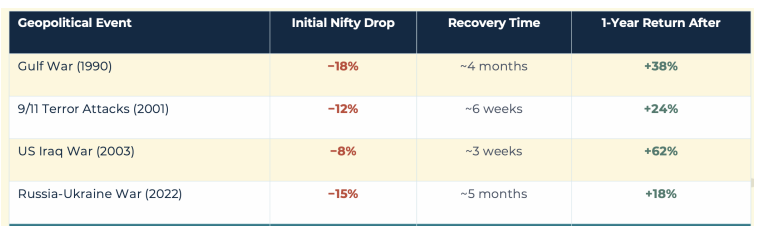
- Market Recovery History: Markets are remarkably resilient to war. During the Russia-Ukraine conflict and the 2023 Middle East tensions, markets initially dipped but often recovered within weeks once the “uncertainty” turned into a “known reality.”
The below chart shows like the resilience for markets to such events in the past.
C) What We Should Be Doing: The Big Picture Strategy
As we look at the last 18 months, the Indian economy has undergone massive structural reforms that provide a safety net during these storms
- Look at the Reforms: Despite the volatility, we have successfully signed FTAs with the UK, EU, and UAE. The India-US Trade Deal of Feb 2026 has significantly de-escalated tariff risks, ensuring our pharma, textiles, and auto-ancillaries remain competitive.
- Focus on Domestic Demand: The 8th Pay Commission and the Personal Income Tax cuts are putting more money in the pockets of Indian consumers. While the world fights, the Indian consumer continues to buy homes, cars, and insurance.
- Use the “Time Correction”: Markets have not given significant returns for nearly 18 months. This “time correction” has made valuations much more attractive. Projected earnings growth for FY27 is moving back into the 12–15% range.
- Stay with Asset Allocation: If you have 10% in Gold/Silver, you are already benefiting from the geopolitical flight to safety. While safety cushions are needed, courageous investments in Equity generate in turbulent times, give rich benefits in the long run
D) What We Should NOT Be Doing: The Trap of Recency Bias
The most dangerous thing an investor can do right now is react to a single day’s news cycle.
- Do Not Panic-Sell: Selling during a “war dip” is historically the worst time to exit. Most geopolitical sell-offs are overdone and recover faster than economic recessions.
- Do Not Get “Social Media Stress”: In 2026, the speed of information is instantaneous, but the quality is often low. Constant doom-scrolling of war footage or AI “doomsday” predictions will only cloud your judgment.
- Avoid Extrapolating One Event: Don’t assume $80 oil today means $150 oil tomorrow. Don’t assume AI automating a task today means the end of the ITsector. Economies are adaptive organisms.
Final Thoughts
The road ahead for 2026 will likely remain choppy, but the destination for the Indian investor remains very bright. We have weathered the “Tariff Bazooka” of 2025, and we will weather the “AI Reality Check” and the West Asian tensions of 2026.
The long-term story of India—driven by a young workforce, massive digital infrastructure, and aggressive policy support—is far more powerful than any shortterm geopolitical shock.
Stay Calm, Stay Invested!
Happy Investing!